Service
Anti-Icing Services for Commercial Properties in Seattle
Liquid brine goes down before the freeze, so ice never bonds to your lot. It is the most cost-effective winter service for most Seattle sites.
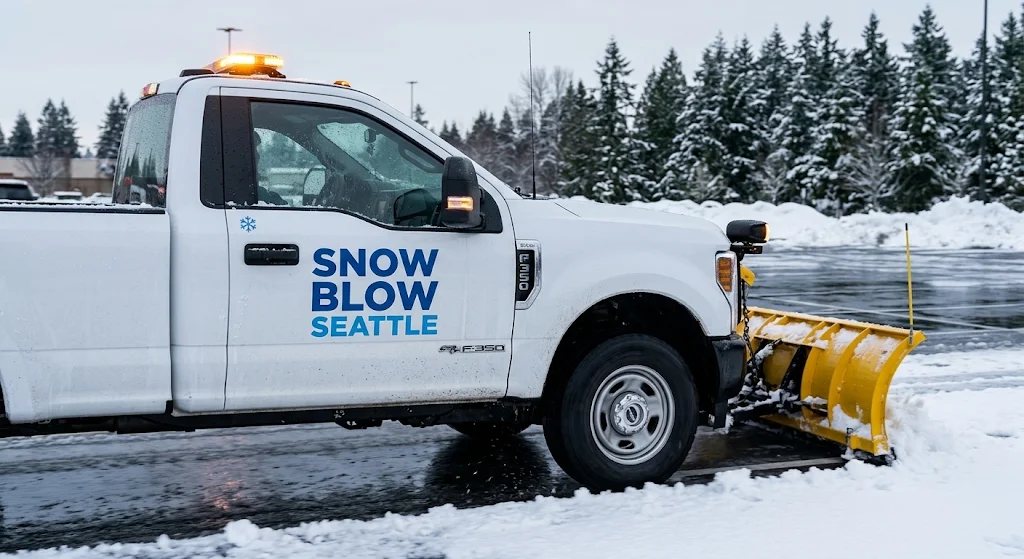
Liquid Brine Pre-Treatment for Seattle Parking Lots
Anti-icing is a liquid salt brine sprayed on pavement ahead of a forecast freeze. As moisture on the surface cools, the brine lowers its freezing point, so ice either does not form or forms weakly and breaks up easily. In western Washington, where cold snaps and freezing rain are more common than deep snow, this is often the service that decides whether you open on time.
Applied on forecast
We apply brine ahead of a predicted freeze, based on forecast and pavement conditions, not a calendar.
Whole-site coverage
Lots, drive lanes, ramps, loading zones and walkways, with extra attention to slopes and shaded corners.
Less product overall
Measured liquid application generally uses less salt than spreading granules after ice has formed.
How an Anti-Icing Application Works
1. Forecast
We flag a freeze risk and call your site contact.
2. Apply
Trucks and sprayers treat the site by zone and priority.
3. Log
Time, product and area treated are recorded.
4. Follow up
We re-check pavement and retreat or plow if conditions change.
If ice forms anyway, we move to De-icing. To see how the two differ, read Anti vs de-icing.
Limits of Anti-Icing
Heavy rain right before a freeze can wash brine off the surface, and brine alone will not melt a thick layer of snow. That is why we pair it with Lot plowing when accumulation is forecast, and why we log each application so you can see what was done.
Anti-Icing FAQs
How far ahead do you apply brine?
Usually hours to a day before a forecast freeze, depending on the forecast. Timing is tuned to rain, temperature and traffic on your site.
Does anti-icing replace plowing?
No. It prevents ice bonding, but it does not move snow. Most contracts use both, with anti-icing first.
Is brine hard on concrete and landscaping?
We match product and rate to the surface and apply measured amounts. Tell us about sensitive concrete, planters or lawn edges and we will plan around them.
Where We Provide Anti-Icing
We provide anti-icing services across Seattle and these nearby cities:
Also see Walkway clearing.